Start with the complaint, not the equipment
The useful question is not whether you need a softener. It is what problem you are trying to solve, because the four common water complaints have four different answers and only one of them is softening.
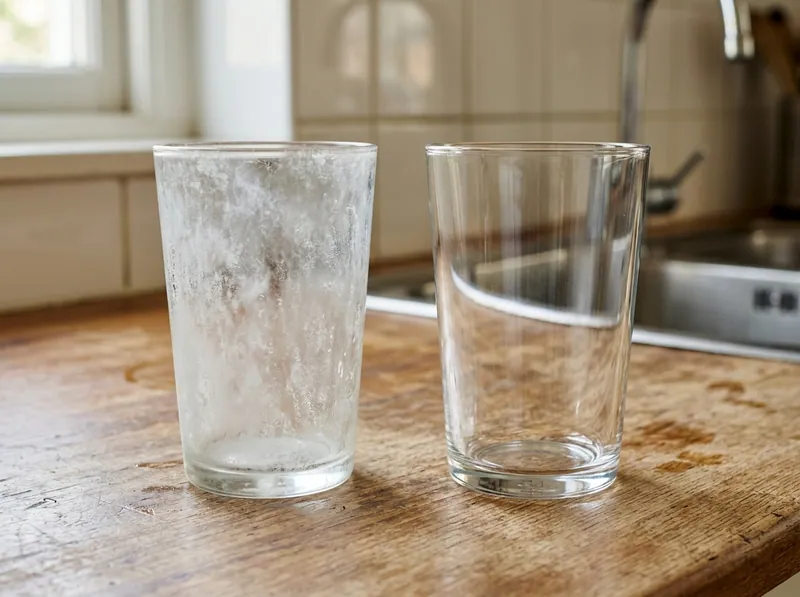
If the complaint is white crust on faucets and shower doors, spots on glassware, soap that will not lather, stiff laundry or a water heater that rumbles and runs out early, that is hardness, and softening is the answer.
If the complaint is a chlorine taste or smell, that is carbon filtration, and a softener will do nothing for it.
If the complaint is cloudy water or grit in the aerators, that is sediment filtration.
If the complaint is low pressure across the whole house, that is a plumbing diagnosis, not a water quality one. It is usually a pressure reducing valve, a partly closed main shutoff or corroded supply lines, and no treatment equipment will change it.
The case for one here
Las Vegas has a stronger case than most cities, and the reason is published rather than promotional. The Las Vegas Valley Water District puts valley hardness at 291 parts per million, or 17 grains per gallon, classed very hard.
At that level, scale is not a marginal effect. It is the normal condition of every heated surface and every sealing surface in the house. Cartridges fail earlier, aerators block, water heaters lose capacity to sediment, and dishwashers spot regardless of what is in them.
If you have invested in the fixtures, the case is stronger again, because higher specification valves have tighter tolerances and finer sealing surfaces, which is precisely what scale affects first.
The honest case against
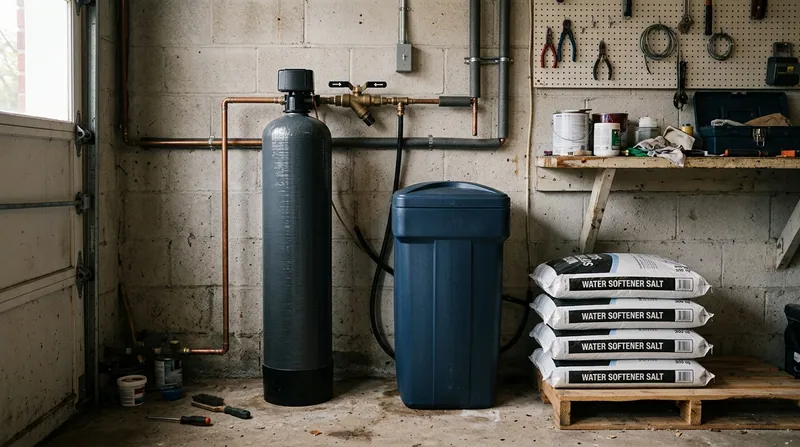
A softener is equipment. It occupies space, it needs a drain and power, it needs salt, and it needs occasional service. If nobody in the household is going to check the salt, the unit will quietly stop working and you will have paid for something that is not doing anything.
It adds a small amount of sodium to the treated water through the ion exchange process. Potassium chloride is the usual alternative for anyone who would rather avoid it, at a higher running cost.
It does not improve taste, and several people find softened water tastes different, which is a matter of preference rather than quality.
And it does not fix the scale you already have. That is a separate job.
Sizing matters more than brand
The most common mistake is buying on brand rather than on capacity. Sizing follows from three things: the hardness of the water, how much water the household uses, and how often you want the unit to regenerate.
At 17 grains per gallon, the arithmetic gives a larger answer in Las Vegas than the same household would need in a soft water city. An undersized unit regenerates constantly, uses more salt, and wears out sooner. That is why a unit matched to the old one on a replacement is so often the wrong choice: it repeats whatever mistake was made the first time.
Before you buy: three checks
Check whether your home already has a softener loop. A large share of newer valley homes were built with the plumbing roughed into the garage and capped, and that makes installation considerably simpler and cheaper than cutting into the main supply.
Check that there is a drain within reach of the installation point, because regeneration discharges brine and needs somewhere to go with a proper air gap.
Check that there is power at the location. A modern control head needs it.
If all three exist, installation is generally straightforward. If none does, the installation cost is a real part of the decision and it should be quoted before you choose equipment.