Find your shutoff now, not later
The single most useful thing in this guide is something to do today, while nothing is wrong.
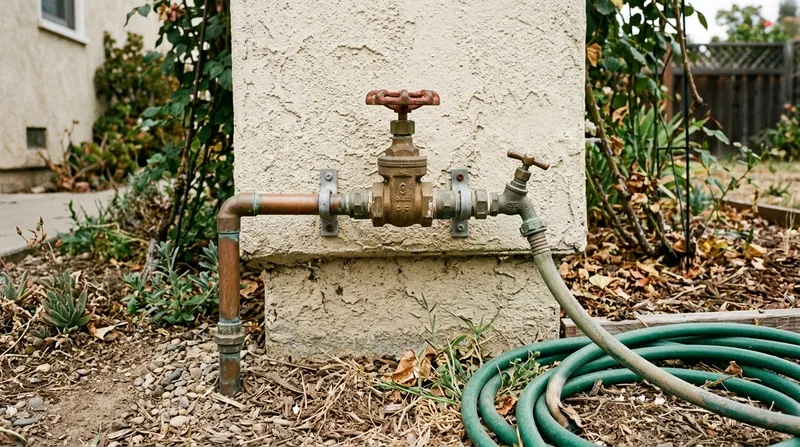
Find your main water shutoff and label it. In most Las Vegas valley homes it is at the front of the house near a hose bib, or in a covered box near the property line. Turn it clockwise to close. Confirm it actually turns, because a valve that has not been operated in fifteen years is often seized, and finding that out during an emergency is the worst possible time.
If it is seized, have it replaced. It is a small job and it is the difference between a contained incident and a flooded house.
Tell everyone in the household where it is. An emergency at two in the morning is not the moment for the only person who knows to be away.
The first five minutes
Close the main shutoff. Everything else is secondary, because water that is still flowing is still doing damage.
If water is anywhere near an electrical outlet, a panel or an appliance, switch that circuit off at the breaker. Do not stand in water to reach a switch, and if the panel itself is wet or you cannot reach it safely, stay out and call the utility.
If the water heater is the source, switch a gas unit to pilot, or switch an electric unit off at its breaker. An electric element firing in a tank that has drained destroys itself within minutes.
Open a fixture at the lowest point in the house, and one upstairs if you have one. This drains the pressure and the standing water out of the pipework rather than letting it continue to escape through the failure.
Then call, and say what you already shut off. That is what decides what comes on the truck.
When waste is coming back into the building
A sewage backup is handled differently, and the instinct most people have is the wrong one.
Stop using water everywhere in the building. All of it. That includes the dishwasher, the washing machine, and flushing toilets in bathrooms that seem unaffected. Every additional gallon goes into a system that already has nowhere to put it, and it comes back up at the lowest fixture.
Keep people away from the affected area. Sewage is a health hazard rather than just a mess, and the cleanup is a different trade from the repair.
Do not pour drain chemicals into a line that is already backed up. It sits there, it does not clear the blockage, and it is a hazard to whoever opens the line.
If more than one fixture is affected at once, this is the main line rather than a single drain, and it is worth saying so when you call.
What is an emergency and what can wait
It is an emergency if water is escaping and you cannot stop it, if waste is coming back into the building, if there is no water at all, or if a water heater is leaking from the tank body.
It can usually wait until normal hours if it is a single dripping fixture, a single slow drain, a running toilet, or a small leak you have successfully isolated at a shutoff valve. Waiting will generally cost you less, because out of hours work is priced differently.
The one thing that is always worth an immediate call, even when it does not look dramatic, is a smell of gas near a gas water heater. Leave the building first and call the gas utility from outside. Nothing about that belongs in a plumbing guide, and nobody should be troubleshooting it themselves.
What to tell us on the phone
What failed, as precisely as you can. A pipe, a fixture, the water heater, or you do not know.
What you have already shut off. Main, a local valve, breaker, gas.
Whether the water is clean or waste, because they are different responses.
How many fixtures are affected, which is what separates a local drain problem from a main line.
The age of the house if you know it, and the pipe material if you know that too.
Those five answers get the right parts on the truck the first time, which on an emergency call is most of the value.